
When Free Speech No Longer Feels Free: A Moment of Reckoning in Dublin

When Free Speech No Longer Feels Free: A Moment of Reckoning in Dublin
Dr. Anthony C

In September, following the EAIE conference in Glasgow, several friends and I traveled to Dublin for a long weekend. The weather was beautiful, the streets were bustling, and the city seemed to be enjoying the last days of summer. We spent our time exploring, enjoying good food, and taking in the warmth and energy of the Irish capital.

We soon learned that President Donald Trump was also visiting Ireland that weekend. His visit was attracting considerable controversy, with Irish news coverage highlighting public opposition to his policies and America’s engagement in international affairs. Although aware of the controversy, we had little idea that we were about to find ourselves in the middle of it.

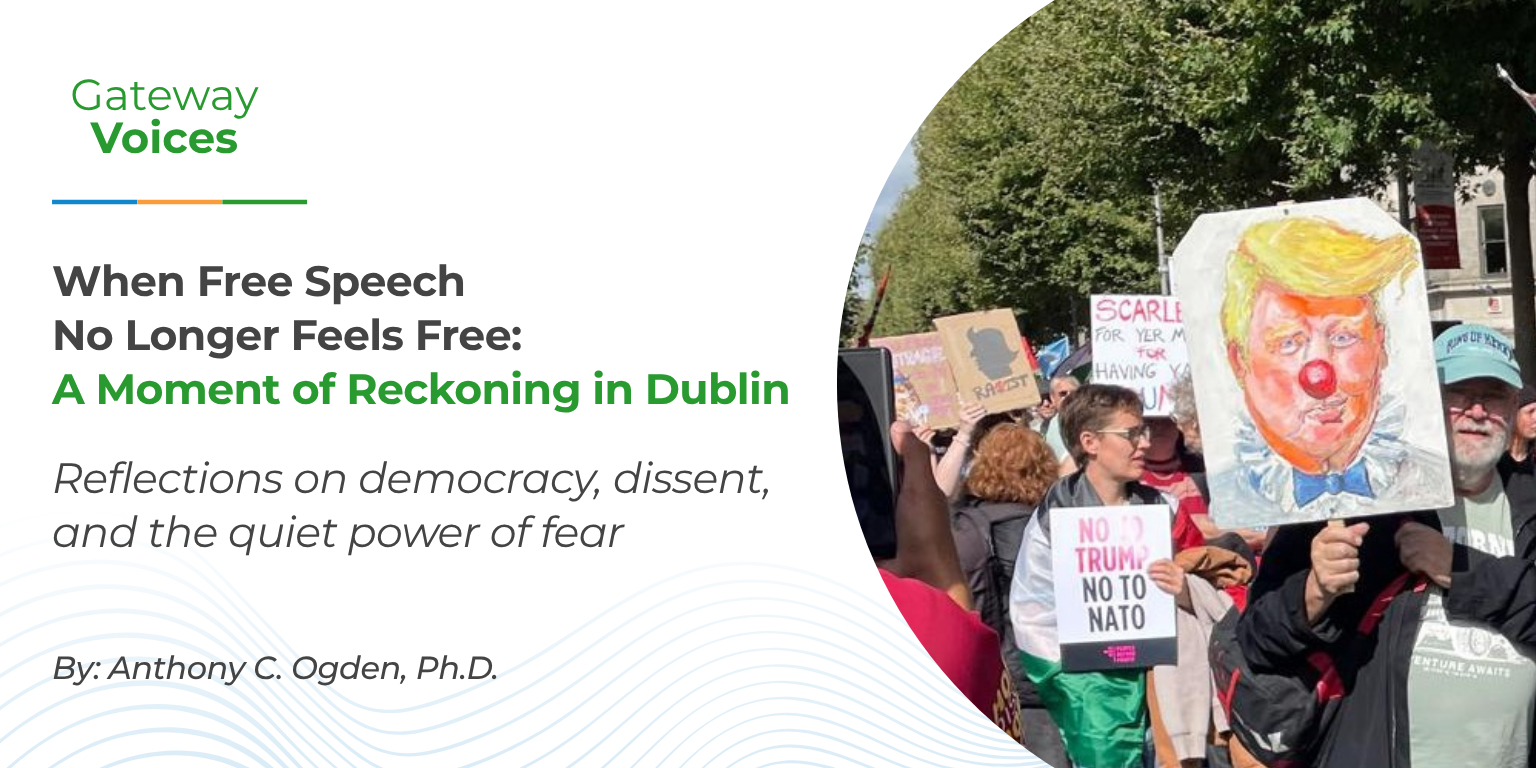
On Saturday, September 12, we had booked a walking tour of Dublin, with instructions to meet our guide at the Spire of Dublin, the towering stainless-steel monument on O’Connell Street, one of the city’s principal thoroughfares. As we made our way toward the meeting point, we encountered an enormous demonstration winding through the city.

Thousands of people had gathered to protest President Trump’s visit and what they perceived as the United States’ increasingly troubling role in world affairs. The streets were filled with chanting protesters carrying banners, placards, and signs condemning American foreign policy, particularly the war in Iran and U.S. support for Israel. Many signs portrayed Trump as a warmonger, tyrant, or dictator. Others employed considerably more colorful language. It was a remarkable display of public dissent.

As my friends and I waited near the Spire for our tour group to assemble, a reporter from the Irish Independent approached me. He had apparently overheard our conversation and recognized my American accent. He asked whether I would be willing to share my reactions to the demonstration. I agreed.

What followed was an unexpectedly candid conversation. He asked about my impressions of the protesters, my views of Donald Trump, the war in Iran, and American support for Israel. I answered openly and frankly, expressing my opinions without much hesitation. Then, as our conversation came to an end, he asked a seemingly innocuous question.

“May I have your name?”

Until that moment, I had given little thought to my comments appearing in print. Suddenly, however, the implications of having my name publicly associated with criticism of the American president became uncomfortably real. Could my remarks attract unwanted scrutiny? Might they be interpreted as disloyal or anti-American? Could there be professional or personal consequences?

I had no reason to believe that this particular interview would attract governmental attention, much less provoke retaliation. Yet the possibility entered my mind, and that was enough.  I declined to provide my name. The reporter accepted my decision, and we parted ways.

But as I walked away, I felt something I had not anticipated. I felt small and weak. Perhaps most troubling, I felt ashamed.

Only moments earlier, I had spoken confidently about democracy, political leadership, and America’s engagement in the world. Yet when given the opportunity to attach my name to those convictions, I hesitated. I had exercised my freedom to speak but had been unwilling to claim ownership of my words. It felt like an act of cowardice.

As an American, I have spent my life taking pride in the democratic principles upon which our country was founded. The First Amendment protects freedom of speech, freedom of the press, and the right to peaceful assembly. These are among the defining commitments of American democracy. Yet standing on a street in Dublin, thousands of miles from home, I found myself questioning whether I could exercise those freedoms without fear of consequences.

To be clear, no one was silencing me. No government official had threatened me, and I had no evidence that retaliation would follow if I identified myself. The decision was mine alone. But that realization made the experience even more unsettling.

What does it say about the health of a democracy when citizens begin to censor themselves, not because they have been forbidden to speak, but because they fear what might happen if they do?

Freedom of expression is more than a constitutional guarantee. It also depends on a political culture in which people feel secure enough to question authority, challenge government policies, and express dissent without fear of reprisal. Legal protections and the lived experience of freedom are not necessarily the same thing.

I have reflected on that moment many times since returning home. I recognize that withholding my name was a personal choice, not evidence that my government would have retaliated. There are legitimate reasons to protect one’s privacy, and anonymity does not invalidate one’s convictions. Should I have given the reporter my name?

Was I being prudent, or was I being cowardly?


As an international educator, I found another lesson in the experience.

Standing among those protesters in Dublin, I was reminded that international education is not simply about encountering other cultures. It is also about confronting how others see our own. As an American, listening to thousands of people express their anger and disappointment with my country was deeply uncomfortable, but also enlightening. I did not lend my voice to theirs, but I heard their message. Perhaps that is one of international education’s most important lessons: the willingness to listen, especially when what we hear challenges our understanding of ourselves and the country we call home.
About the author: Based in Pennsylvania, Dr. Anthony C. Ogden is a highly respected educator, each with decades of experience advocating for innovation in international higher education. He is the founder and managing director of Gateway International Group and co-editor of Preparing Students for a Global World (Cambridge Scholars Publishing, 2026).

Leave a Reply

Share this on:
Facebook
Twitter
LinkedIn

Sponsored ad

Sponsored ad

Sponsored ad

Sponsored ad

Episode 29: Cultural Lens on U.S. Higher Education: Analyzing International Perceptions of 'Anti-Woke’ Discourse

Dive into a nuanced exploration of the global discourse surrounding higher education in the United States. Join us for a panel discussion with esteemed international educators as we embark on a journey through the lenses of culture and international perspective, examining how global audiences interpret and engage with the ‘anti-woke’ discourse within the context of U.S. higher education. This engaging panel discussion will delve into the intersections of culture, ideology, and education, and the complex landscape of how international audiences perceive the ‘anti-woke’ narrative that has emerged within U.S. academia.

Whether you’re a senior international officer, or simply curious about the diverse viewpoints shaping U.S. higher education, this podcast episode will provide an invaluable space for critical analysis and insightful conversations.

Speaker Biography:

Fanta Aw is a distinguished leader in international education, renowned for her extensive contributions to global learning, cross-cultural understanding, and educational equity. With a deep commitment to fostering connections between diverse cultures and promoting educational excellence, she has significantly impacted the international education community.

Fanta Aw’s career has been characterized by her dedication to advancing global education initiatives, promoting diversity and inclusion, and nurturing partnerships that transcend borders. She has held influential roles in various organizations, advocating for the importance of international collaboration and learning experiences that empower individuals to navigate an increasingly interconnected world.

As a thought leader and visionary, Fanta Aw’s insights and expertise have shaped discussions on the future of international education, emphasizing the significance of equitable access, cultural exchange, and lifelong learning. Her work has not only elevated institutions but has also inspired countless individuals to embrace the transformative power of global education.

Date: September 14th, 2023
Time: 12 noon ET

Sponsored by:

Mark Beirn

AFFILIATE

An experienced global researcher and administrator, Mark Beirn brings a critical approach to risk management, factoring structural racism and identity-based violence into his rubric for supporting equitable global mobility.

Specialization Areas:

– Global Risk Management
– Education Abroad
– Diversity, Equity, Inclusion in International Education
– Health and Safety
– Curriculum Development


Stephen Appiah-Padi​

AFFILIATE

Stephen Appiah-Padi is an international educator with several years of teaching and administrative experience in both 4 and 2-year HEIs. An experienced global education practitioner-scholar, with a demonstrated history of success in the field.

Dr. Appiah-Padi has a Ph.D. from the University of Alberta, Edmonton, Canada in Educational Policy & Administration with a specialization in International/Intercultural Education.

At Northwestern College, he provided oversight in the administration of education abroad and international student services. In Lansing, Michigan, he first oversaw diversity and intercultural education at Lansing Community College, and later created the Center for International and Intercultural Education (CIIE) which merged intercultural engagement and international education programs of the institution, and he became its first director. Additionally, Dr. Appiah-Padi taught a course, “Diversity in the American Workplace”, to undergraduate management students of the College. In his current position, he provides leadership and vision in advancing strategic internationalization initiatives, including international partnerships and study abroad programs at Bucknell University.

Dr Appiah-Padi has created and facilitated several workshops for faculty and staff development in higher education and in business organizations. He has presented at several national and international conferences. In NAFSA, among several volunteer leadership positions, he has served as Dean of the Fundamentals of Intercultural Communication Workshop, the Leadership Development Committee member, Chair of the Africa Special Interest Group, and a Fellow of the Global Fellowship Program for mentoring emerging leaders of internationalization in African HEIs. He currently serves as a member of the NAFSA Board of Directors.

Rosa Almoguera

AFFILIATE

Dr. Rosa Almoguera has worked as an international educator for over twenty years. She was trained as a Hispanic Philologist at the Universidad Complutense, in Madrid, and did her M.A. at the University of Pennsylvania. Her Ph.D., from Universidad Complutense included a field study and edition of written balladry “Romancero”. During many years Rosa combined teaching and her role as a senior administrator at the Fundación Ortega-Marañón in Toledo, Spain. At the Foundation, Rosa directed and, in many cases created, programs for the University of Minnesota, Notre Dame, Princeton, Ohio State, Arcadia, and the University of Chicago. She has also been a visiting professor at the University of Minnesota, University of Portland, and Interamericana de Puerto Rico.

Beginning in 2016, Rosa works as an international education consultant for both public and private European and US higher education institutions. Rosa has been successful in developing new partnerships and programs, as well as helping improve already existing ones.

Rosa is a member of Forum and NAFSA and has presented with higher education professionals on innovative academic and research programming, STEM in study abroad and Nationalism in Europe. Rosa is currently completing the final Professional Certification from the Forum on Education Abroad.