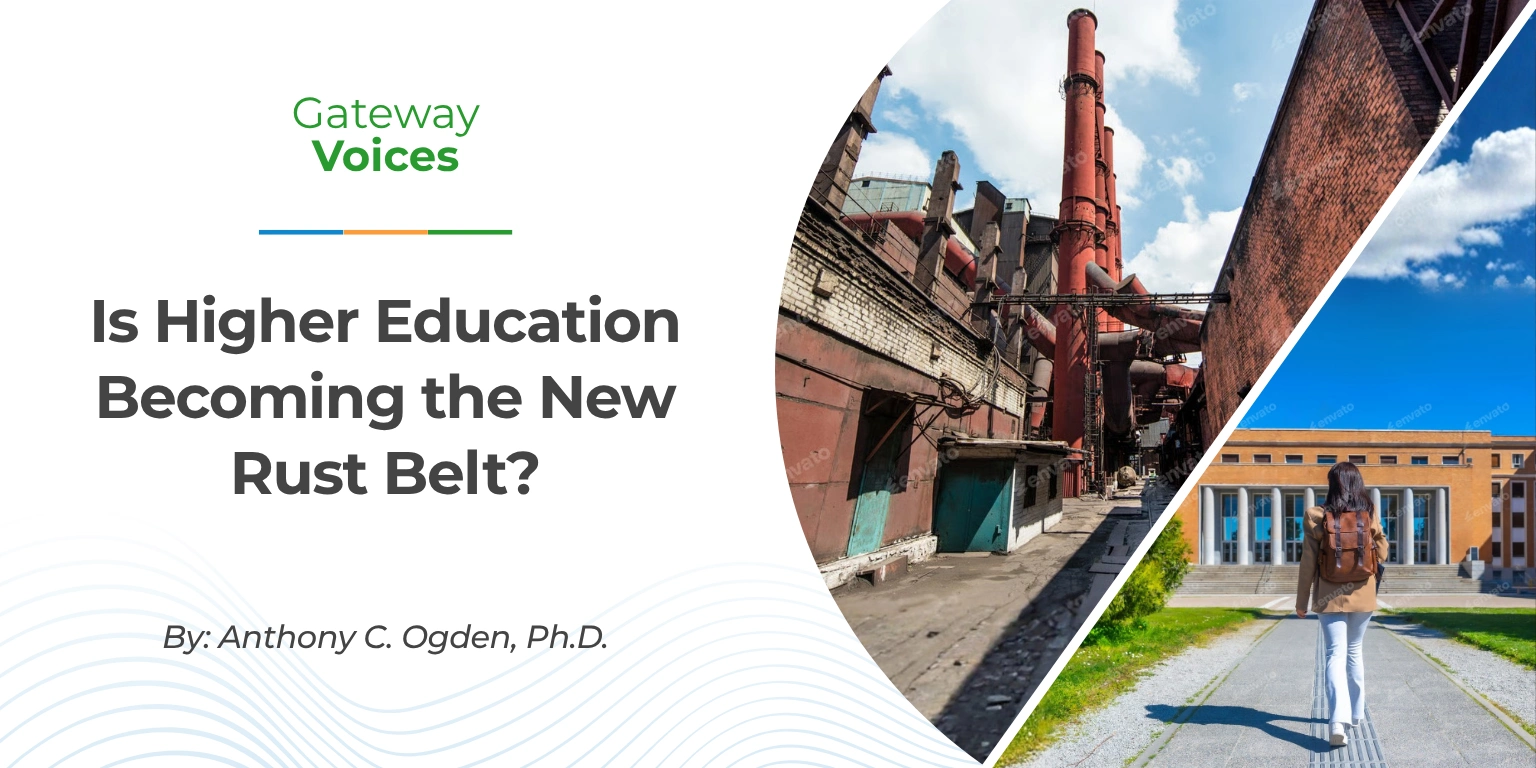

Is Higher Education Becoming the New Rust Belt?

Is Higher Education Becoming the New Rust Belt?
Anthony C. Ogden

For decades, American higher education occupied a position of near unquestioned dominance. Universities were engines of innovation, pathways to social mobility, anchors of regional economies, and symbols of national prestige. Much like manufacturing in the middle of the twentieth century, U.S. higher education was viewed not simply as a sector, but as part of the American identity itself.

Today, however, a different vocabulary increasingly defines conversations across the sector: demographic cliff, consolidation, institutional vulnerability, public distrust, political scrutiny, and existential uncertainty.

Recently, a colleague described the current moment in higher education as resembling the early stages of the Rust Belt. The comparison immediately resonated with me—not because universities and steel mills are the same, but because the structural pressures surrounding them are becoming surprisingly familiar.

The Rust Belt was once the industrial heart of the United States. Cities across Pennsylvania, Ohio, Michigan, and Indiana thrived on assumptions that manufacturing dominance would continue indefinitely. Yet globalization, automation, demographic shifts, political change, and technological transformation fundamentally altered the landscape. Entire regions built around those assumptions suddenly found themselves confronting overcapacity, declining demand, labor disruption, and identity crises (Austin, 2017; Smith 2023; The Philadelphia Inquirer, 2019).

American higher education now faces a remarkably similar convergence of pressures.

Many institutions were built for an era of continual enrollment growth, expanding public investment, and broad societal confidence in the value of a university degree. Those assumptions appear to be weakening.

In many parts of the United States, the number of traditional college-age students is projected to decline over the coming decade. Smaller private colleges and regional public institutions are already facing mounting financial pressure. Public skepticism regarding cost, value, and ideology has intensified. Artificial intelligence and digital learning technologies are beginning to challenge long-standing assumptions about educational delivery and student engagement.

Meanwhile, universities increasingly operate within a globally competitive environment in which students, research partnerships, and talent are no longer guaranteed to flow toward the United States, particularly as immigration restrictions and visa policies under the Trump administration are intentionally limiting high-achieving international students and researchers from studying or working in the country.

Like manufacturing before it, higher education is also experiencing growing stratification.

Elite and globally recognized institutions continue to attract students, research funding, philanthropic investment, and international partnerships. Flagship universities with strong brands and research capacity remain comparatively resilient (Putzier, Belkin, & DeBarros, 2025). Yet many tuition-dependent institutions find themselves caught in a precarious middle ground—too large to remain nimble, too small to compete globally, and too dependent on enrollment models that may no longer be sustainable.

The parallels are difficult to ignore.

Rust Belt Industrial EraHigher Education Today
Manufacturing dominanceDegree monopoly and institutional dominance
Offshoring and globalizationGlobal competition and transnational education
AutomationAI and digital learning
Factory closuresInstitutional mergers and closures
Population decline in industrial regionsEnrollment cliffs and demographic decline
Consolidation into industrial hubsConcentration around elite universities
Company townsCollege towns
Declining trust in institutionsPublic skepticism toward higher education

The comparison extends beyond economics.

The Rust Belt was also a story of cultural and psychological disruption. Communities built around manufacturing lost not only jobs, but also a sense of collective purpose and institutional trust.

Higher education increasingly confronts a comparable challenge. Universities are less likely to be perceived as serving the public good. Debates over political ideology, freedom of expression, workforce relevance, and affordability, have fundamentally reshaped public perceptions of higher education’s role in society.

At the same time, universities remain uniquely adaptive institutions. Unlike factories, universities generate research, talent, innovation, healthcare partnerships, and global engagement. They possess intellectual and creative capacity that can support reinvention in ways industrial infrastructure often could not.

Higher education itself is certainly not going to disappear. Demand for advanced learning, workforce development, research, and lifelong education will persist. The question is not whether higher education will survive, but rather what form it will take.

The institutions most likely to thrive will likely be those willing to recognize that this moment represents structural transformation rather than temporary disruption. They will diversify revenue streams, embrace technological change thoughtfully, strengthen international partnerships, align more directly with workforce and societal needs, and develop clearer institutional identities. They will become more agile, collaborative, and globally connected.

In that sense, the Rust Belt analogy should not necessarily be interpreted as fatalistic. Some regions in the Rust Belt adapted successfully because leaders recognized early that the underlying economic and societal realities were fundamentally changing. U.S. higher education may now stand at a similar crossroads.

References

Austin, J. C. (2017, December 20). Tale of two Rust Belts: Higher education is driving Rust Belt revival, but risks abound. Brookings Institution. https://www.brookings.edu/articles/tale-of-two-rust-belts-higher-education-is-driving-rust-belt-revival-but-risks-abound/

The Philadelphia Inquirer. (2019, December 3). Pennsylvania is the Rust Belt of higher education. https://www.inquirer.com/

Smith, N. (2023, January 16). How college towns can survive and thrive. Noahpinion. https://www.noahpinion.blog/p/how-college-towns-can-survive-and

Putzier, K., Belkin, D., & DeBarros, A. (2025, May 18). America’s college towns go from boom to bust. The Wall Street Journal. https://www.wsj.com/

About the author: Based in Pennsylvania, Dr. Anthony C. Ogden is a highly respected educator, each with decades of experience advocating for innovation in international higher education. He is the founder and managing director of Gateway International Group and co-editor of Preparing Students for a Global World (Cambridge Scholars Publishing, 2026).

Leave a Reply

Share this on:
Facebook
Twitter
LinkedIn

Sponsored ad

Sponsored ad

Sponsored ad

Sponsored ad

Discover more from Gateway International Group

Subscribe now to keep reading and get access to the full archive.

Continue reading

Episode 29: Cultural Lens on U.S. Higher Education: Analyzing International Perceptions of 'Anti-Woke’ Discourse

Dive into a nuanced exploration of the global discourse surrounding higher education in the United States. Join us for a panel discussion with esteemed international educators as we embark on a journey through the lenses of culture and international perspective, examining how global audiences interpret and engage with the ‘anti-woke’ discourse within the context of U.S. higher education. This engaging panel discussion will delve into the intersections of culture, ideology, and education, and the complex landscape of how international audiences perceive the ‘anti-woke’ narrative that has emerged within U.S. academia.

Whether you’re a senior international officer, or simply curious about the diverse viewpoints shaping U.S. higher education, this podcast episode will provide an invaluable space for critical analysis and insightful conversations.

Speaker Biography:

Fanta Aw is a distinguished leader in international education, renowned for her extensive contributions to global learning, cross-cultural understanding, and educational equity. With a deep commitment to fostering connections between diverse cultures and promoting educational excellence, she has significantly impacted the international education community.

Fanta Aw’s career has been characterized by her dedication to advancing global education initiatives, promoting diversity and inclusion, and nurturing partnerships that transcend borders. She has held influential roles in various organizations, advocating for the importance of international collaboration and learning experiences that empower individuals to navigate an increasingly interconnected world.

As a thought leader and visionary, Fanta Aw’s insights and expertise have shaped discussions on the future of international education, emphasizing the significance of equitable access, cultural exchange, and lifelong learning. Her work has not only elevated institutions but has also inspired countless individuals to embrace the transformative power of global education.

Date: September 14th, 2023
Time: 12 noon ET

Sponsored by:

Mark Beirn

AFFILIATE

An experienced global researcher and administrator, Mark Beirn brings a critical approach to risk management, factoring structural racism and identity-based violence into his rubric for supporting equitable global mobility.

Specialization Areas:

– Global Risk Management
– Education Abroad
– Diversity, Equity, Inclusion in International Education
– Health and Safety
– Curriculum Development


Stephen Appiah-Padi​

AFFILIATE

Stephen Appiah-Padi is an international educator with several years of teaching and administrative experience in both 4 and 2-year HEIs. An experienced global education practitioner-scholar, with a demonstrated history of success in the field.

Dr. Appiah-Padi has a Ph.D. from the University of Alberta, Edmonton, Canada in Educational Policy & Administration with a specialization in International/Intercultural Education.

At Northwestern College, he provided oversight in the administration of education abroad and international student services. In Lansing, Michigan, he first oversaw diversity and intercultural education at Lansing Community College, and later created the Center for International and Intercultural Education (CIIE) which merged intercultural engagement and international education programs of the institution, and he became its first director. Additionally, Dr. Appiah-Padi taught a course, “Diversity in the American Workplace”, to undergraduate management students of the College. In his current position, he provides leadership and vision in advancing strategic internationalization initiatives, including international partnerships and study abroad programs at Bucknell University.

Dr Appiah-Padi has created and facilitated several workshops for faculty and staff development in higher education and in business organizations. He has presented at several national and international conferences. In NAFSA, among several volunteer leadership positions, he has served as Dean of the Fundamentals of Intercultural Communication Workshop, the Leadership Development Committee member, Chair of the Africa Special Interest Group, and a Fellow of the Global Fellowship Program for mentoring emerging leaders of internationalization in African HEIs. He currently serves as a member of the NAFSA Board of Directors.

Rosa Almoguera

AFFILIATE

Dr. Rosa Almoguera has worked as an international educator for over twenty years. She was trained as a Hispanic Philologist at the Universidad Complutense, in Madrid, and did her M.A. at the University of Pennsylvania. Her Ph.D., from Universidad Complutense included a field study and edition of written balladry “Romancero”. During many years Rosa combined teaching and her role as a senior administrator at the Fundación Ortega-Marañón in Toledo, Spain. At the Foundation, Rosa directed and, in many cases created, programs for the University of Minnesota, Notre Dame, Princeton, Ohio State, Arcadia, and the University of Chicago. She has also been a visiting professor at the University of Minnesota, University of Portland, and Interamericana de Puerto Rico.

Beginning in 2016, Rosa works as an international education consultant for both public and private European and US higher education institutions. Rosa has been successful in developing new partnerships and programs, as well as helping improve already existing ones.

Rosa is a member of Forum and NAFSA and has presented with higher education professionals on innovative academic and research programming, STEM in study abroad and Nationalism in Europe. Rosa is currently completing the final Professional Certification from the Forum on Education Abroad.