There is a wealth of research to suggest studying abroad offers a range of benefits for student participants, including enhanced cultural understanding, increased global awareness, and development of intercultural competency, among others. Yet, the research often leaves out the critical perspective of students. Here, we aim to do just that–highlight the voices of University of Illinois Chicago (UIC) students who participated in faculty-directed study abroad programs. The students’ perspectives offer valuable insights into the impact their study abroad experience has had, particularly in terms of their development of critical skills and how these experiences have shaped their early professional trajectories.
Study Abroad at a Large Urban University
UIC is a large urban public research university, just west of downtown Chicago. The university enrolls more than 35,000 undergraduate, graduate, and professional students and is widely recognized for the diversity of its student body, being federally designated as both a Hispanic-Serving Institution (HSI) and an Asian American and Native American Pacific Islander-Serving Institution (AANAPISI). More than half of UIC students identify as students of color and as first-generation college students, representing a broad range of racial, ethnic, linguistic, socioeconomic, and immigration backgrounds. This diversity, rooted in UIC’s urban mission and commitment to access, equity, and social mobility, informs the university’s teaching, research, and community-engaged work, positioning UIC as a national leader in inclusive higher education. Study abroad at UIC is also shaped by students’ extraordinary diversity and the university’s commitment to access. UIC students who go abroad bring a wide range of cultural, linguistic, and lived experiences that shape intercultural learning in distinct ways, fostering reciprocal engagement and critical awareness within global learning contexts. Indeed, the diversity of students’ backgrounds informs every classroom on campus and every study abroad program.
UIC’s short-term, faculty-directed programs are especially impactful for first-generation, low-income, and working students, offering affordable, well-supported global experiences that broaden perspectives and strengthen intercultural skills. Since resuming study abroad after the COVID-19 pandemic, the university has seen a 74.5% increase in study abroad participation, primarily attributed to the strategic development of short-term faculty-directed programs.
The Impact of Short-Term Study Abroad Programs
Short-term study abroad programs have experienced rapid growth in recent decades, providing students with meaningful global learning experiences in a compact format. Typically lasting anywhere from one to eight weeks, these programs provide several advantages over traditional semester-long exchanges. Due to their shorter time frame, they are more affordable, making study abroad accessible to a wider range of students who may not be able to commit to the cost of a full semester overseas. This also helps address the “opportunity cost” that students often face when considering study abroad, as well as the realities of needing to work or complete an internship. For institutions that serve a diverse student body with many first-generation college students, they provide an excellent path to introduce international education to students who may be less familiar with the opportunities and procedures of international travel. Short-term programs can be especially appealing to students with jobs, family responsibilities, or other commitments that make longer travel difficult. As a result, they have become an important pathway for expanding access to international education across higher education. UIC’s investment in faculty-directed programs has shown great promise in creating a culture of study abroad at the institution.
Against this institutional backdrop, UIC’s study abroad programs become powerful extensions of the university’s mission to advance access, equity, and transformative learning. The true impact of study abroad is most clearly seen through the lived experiences of students themselves. The following two student narratives illustrate how UIC students engage in global learning in personal and professionally meaningful ways, translating international experiences into growth, purpose, and expanded possibilities.
Aaron’s Story
Aaron Stanaway is a 2024 graduate of the UIC Urban Education program in the College of Education. Aaron first studied abroad in the spring of 2022 when he participated in the Education, Globalization, and the Child program in Brazil. He later joined the First Year Flames Abroad program in Costa Rica as a student leader in the summer of 2023. Today, Aaron is a 5th and 6th grade teacher at Escuela Lomas Altas school in Mexico City. Here, Aaron shares how his UIC study abroad experiences had an impact on his academic and professional trajectory.
I never would have imagined that studying abroad would impact my career and life trajectory in the way that it did. Prior to studying abroad, my GPA was falling, my ADHD was mismanaged, and I didn’t think I’d be able to pull myself back up. Then, I had the opportunity to study abroad on a faculty-led program for 10 days in Sao Paulo and Rio de Janeiro, Brazil. That experience gave me so much momentum and was the catalyst for me to work hard and ultimately flip my GPA by the end of the semester.
As an undergraduate student studying Urban Elementary Education, my time in Brazil opened my eyes to how schools around the world prioritize education and how vastly different schools can be across contexts. Seeing so many schools in Brazil gave me the opportunity to see first hand how culture, socioeconomics, and place impact childhood and education. I learned so much about education, and even more about myself. Studying abroad in Brazil gave me the opportunity to see myself as a leader, something I never considered before.
When returning to Chicago, I began to work for UICs Study Abroad Office, applying my experience to assist other students in finding the right study abroad program to participate in. This opportunity led me to participate in yet another program– traveling with newly admitted first-year UIC students to Costa Rica as a student leader. During this program, I leaned into my teaching and leadership skills and started to consider teaching abroad.
After two study abroad experiences, I knew I wanted to teach abroad after graduation! Over the span of two years, my confidence was growing at a rate I hadn’t felt in such a long time. I was incredibly connected to my courses, my professors, meeting new people in class and around the campus, and even spearheaded a Study Abroad Alumni program through the Study Abroad Office. It was studying abroad that helped me unlock this new level of leadership that I always had within, but I just needed more confidence. My supervisor in the Study Abroad Office, Kenny, helped me enroll in a TEFL (Teaching English as a Foreign Language) program which would allow me to teach internationally– anywhere in the world. As I was already learning Spanish from my friend who lived in Mexico City, I naturally gravitated towards learning more about schools in Mexico City.
Today, I am utilizing my university education and international experience to teach 5th and 6th graders in an IB (International Baccalaureate) World School in Mexico City. When I interviewed for this job, I felt incredibly comfortable discussing my experiences abroad, as well as what I learned during my time as a student teacher in Chicago Public Schools and a student at UIC. I truly believe it was this combination of experiences that led me to this position. I feel so lucky to live and work in Mexico City as an early-career teacher while furthering my Spanish skills. Every day I challenge myself to lean into leadership opportunities as I continue to build my confidence and push myself to be the best version of myself. If it weren’t for the impulsive email I sent in spring 2022 to the Brazil program leader, Jennifer Olson, I don’t think I would be where I am today.
Anissa’s Story
Anissa Comas is a first-generation two-time UIC graduate who participated in four study abroad programs during her time at UIC. Like Aaron, Anissa first studied abroad in the spring of 2022, when she participated in the Education, Globalization, and the Child program in Brazil. She also served as a First Year Flames Abroad program student leader in Costa Rica during the summer of 2022. Anissa then participated in the Seminar in Psychology: Gender-Based Violence, Racism, and Social Services in Paris program and Language Policy, Identity, and Ability in the Basque Country program in Spain during her time at UIC. She graduated in 2023 with a BA in Human Development and Learning, and in 2025 she earned her MEd in Early Childhood Education. Today, Anissa is an early childhood teacher at Easterseals Gilchrist Marchmann Childhood Development Center. Here, Anissa shares how her four UIC study abroad experiences have impacted her life and her career as an educator.
It only took one study abroad program in Brazil for me to become a study abroad addict. Studying abroad has not only changed the way I experience the world but also how I engage with education and interactions with others. It has influenced my values and beliefs in ways I never knew were possible. I now embrace the unknown and what it may bring every day. Every study abroad program I participated in forced me to come face-to-face with new, unknown experiences and try to embrace and navigate them. These experiences truly prepared me to be a more capable educator today.
I participated in four UIC study abroad programs, all of them faculty-directed. Having UIC faculty members travel alongside the group allowed me to comfortably navigate the unknown, in a safe and supportive way. My first study abroad experience in Brazil was just when we were coming out of the global pandemic, and travel was still unpredictable. Without the support of my classmates and my professor, Jennifer Olson, I never would have participated in the program.
I could have very easily pulled out of the course because of fear of the unknown, but because of my classmates and professor I didn’t and that one choice has forever changed the trajectory of my life. Studying abroad taught me to embrace the unknown in everything that I do, even when it is scary because I know that the risk can reap such wonderful rewards.
While in Brazil, I had the opportunity to gain a better understanding of schools, education policy, and the impact that teachers have on students. I loved the long days of school visits and long conversations with peers about education over dinner. I jumped into every new experience enthusiastically, whether we were collaborating with Brazilian students, exploring new neighborhoods, or enjoying Brazilian culture, I loved it all. I knew I wanted to study abroad again before I even returned home to Chicago.
The very same year, I was chosen to be a student leader in Costa Rica, where I supported first-generation students as they navigated a new country, volcano hikes, cultural differences, and the worries of transitioning to college. The next year, in Paris, I had the chance to compare how social services are offered to the residents of Chicago and Paris, which allowed me to really start thinking more globally. After graduating with my BA, I went directly into an MEd program and almost immediately signed up to study abroad in Bilbao, Spain, where I studied critical perspectives on language policy and dying languages like Euskera. This final study abroad experience felt like a culmination of my previous study abroad programs. It integrated the educational focus of Brazil through visits to local schools, the social service lens of Paris by examining how education supports individuals with disabilities, and the emphasis on leadership and collaboration I encountered in Costa Rica through joint research with classmates and community members in Bilbao. We live in such a connected world, and it’s amazing to be able to take advantage of all the opportunities technology gives us to learn about one another and to learn from one another.
All these experiences have come together to create the mindset that I have now and use in my everyday life as an educator in Chicago. I encounter children from different walks of life and abilities, and being open-minded to their differences is vital to creating a safe educational space for them. I would not have developed the confidence and tools to create meaningful impact without taking that leap of faith and embracing the unknown while studying abroad.
Conclusion
Aaron and Anissa’s stories remind us that study abroad is more than travel; it’s a catalyst for development. Short-term, faculty-directed programs can spark renewed academic engagement, open doors to new career paths, and help students clarify their goals. For first-generation and underrepresented students, these programs provide a supportive entry point into international education, easing concerns while building confidence and skills for future global opportunities. Beyond personal growth, study abroad equips students with critical competencies like leadership, adaptability, and the ability to navigate differences, skills that employers value in today’s interconnected world. As questions about the return on investment in higher education persist and funding for international programs faces uncertainty, it is essential to empower students to share their stories. Their experiences demonstrate that study abroad is not a luxury; it’s a high-impact practice that delivers lasting personal and professional benefits.
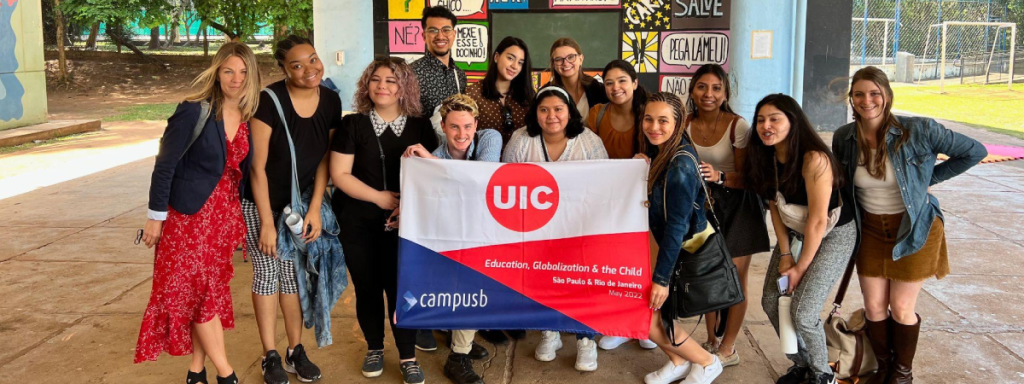
Brazil 2022: Students at University of Sao Paulo College of Education
Anissa: holding the flag on the right
Aaron: 4th from the left holding the flag

Brazil 2022: Students visiting with Lutgardes Costa Freire (Paulo Freire’s son) at Paulo Freire Institute
Anissa: 3rd from left
Aaron: first from right in the back row

Brazil 2022: Students touring Rio de Janeiro Rio City Center, known as Centro, the historic heart of Rio de Janeiro
Anissa: 7th from the left, in the middle
Aaron: 2nd from left

Brazil 2022: Students at a public school in Rio de Janeiro
Anissa: 4th from left, holding flag
Aaron: 4th from right